Why a Public Bench Changes the Pace of a Street
A public bench can turn a street from a route into a place to pause. Notice who can reach it, use it comfortably, and linger without feeling in the way.
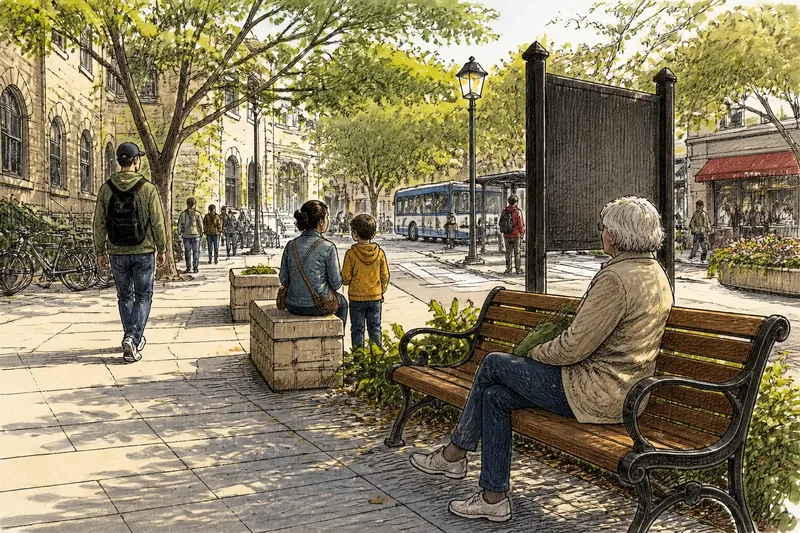
The most common mistake in judging a public bench is to count it as an object rather than ask what it lets someone do. A bench can turn an ordinary street into a place to pause, but a seat tucked behind a planter, exposed to traffic spray, or blocked by a delivery cart may invite almost no one to stay. Notice the bench in use, and the street around it starts to tell a more useful story.
A bench changes the street from passage to pause
On a route without places to sit, people tend to keep moving. They may slow to check a phone, wait for a companion, or look for an address, but the street still treats them as passersby. A seat offers another option: stop without having to buy anything or explain why you are there.
That change can be small and still matter. Someone carrying grocery bags can rest before crossing to a bus stop. A caregiver can wait while a child watches the sidewalk activity. A person who walks slowly can take a break without turning back. The bench makes a short stay ordinary rather than exceptional.
Think of a bench as a bookmark in a long route. It does not replace the journey; it gives people a place to pick it up again. Where it sits matters as much as whether it exists. A seat along a shaded block may serve a different group and purpose from one beside a busy corner, and a row of seats facing a blank wall may feel different from a seat angled toward a small plaza.
Read the seat and its surroundings together
Pause nearby and look at the whole setting, not only the bench. Is there a clear path to reach it? Can someone sit without blocking a doorway, curb ramp, or narrow sidewalk? Does the spot offer shade, wind shelter, or a view of something people might enjoy watching? These are observations about how the place works, not a verdict on the people using it.
Listen for the street’s competing rhythms. A bench near a school entrance may be lively at dismissal and quiet at other times. Near a bus stop, people may use it while watching for their ride. On a retail block, a seat can become a meeting point between errands. A single visit captures only one moment, so notice whether the scene changes during the day or across ordinary weekday and weekend routines.
Also look at what a seated person faces. A view of trees, a storefront, a play area, or the movement of the street can make a pause feel connected to the neighborhood. A seat aimed directly at a wall or a loading area may be less appealing, though some people may value the privacy. Avoid assuming that every user wants the same degree of visibility or conversation.
Notice who the street makes room for
To understand whom a bench invites, pay attention to access and choice. Can people approach it from the sidewalk without stepping over an obstacle? Is there room for a wheelchair user or someone with a stroller to remain beside a seated companion? Does the seat have a back or armrests that may make sitting down and standing up easier for some people? A bench does not need to meet every need on its own, but the nearby space should not make ordinary use unnecessarily difficult.
Watch for signs of welcome as well as signs of friction. People may sit alone, talk in pairs, eat a snack, watch children, or wait for a ride. Others may pause nearby without sitting. Notice whether the location feels exposed, noisy, or too close to a doorway, and whether people seem to have enough space to pass one another. Do not identify or photograph strangers just to record these patterns; a general note about the setting is usually enough.
Look, too, for who seems able to linger without being questioned or hurried along. If some people use the bench while others hover at its edge, the difference may relate to comfort, mobility, social expectations, or the way the space is managed. A brief observation cannot tell you which explanation is right. It can point to a better question: what about this spot makes one kind of pause easier than another?
Notice who a public bench invites to linger?
What should I observe before deciding whether a bench is welcoming?
Look at the approach, the space beside the seat, the view, and the street activity around it. Then notice who uses the spot and whether anyone appears to wait nearby without settling in.
How long should I watch the street?
There is no single observation period that suits every location. A short visit at more than one ordinary time can reveal whether the bench serves different routines or stays empty through changing conditions.
Does an empty bench mean people do not want seating?
Not necessarily. Weather, noise, poor placement, nearby construction, or the timing of your visit may affect use, so check the surrounding conditions before drawing a conclusion.
What if people use the bench differently than I expected?
Record the behavior without treating it as a problem. People may use public seating to rest, wait, talk, eat, or simply watch the street, and those varied uses are part of what makes the space public.
Make a short observation without turning people into data
A useful field note can be simple. Choose a public place with a bench, stand where you can see the seat and its approach, and write down what the setting allows. Keep attention on the physical arrangement and general patterns rather than names, identifying details, or assumptions about why someone is there.
- Approach: Note whether the route to the bench is clear or interrupted by signs, parked bicycles, merchandise, or street furniture.
- Comfort: Record visible shade, wind, rain exposure, noise, and whether the seat has a back or armrests.
- Choice: Notice whether people can sit alone, sit together, or remain beside the bench without blocking the main path.
- Activity: Describe broad uses such as resting, waiting, conversation, or watching nearby activity.
- Timing: Note the general time and conditions, such as a school release, a market day, or a quiet morning.
- Friction: Record any obstacle or conflict between seating and movement, without assuming who is responsible.
Say you visit a small plaza beside a library and find the bench partly screened by a sign. A parent waits nearby while a child watches the sidewalk, and a person carrying a bag sits at the far end. You note that the approach is open, the sign interrupts the view from one side, and the bench is comfortable for a short rest. On another visit, you might see whether the same obstruction affects people arriving from a different direction. The point is not to prove who uses the plaza; it is to notice how placement shapes the choices available.
Separate a seating problem from a seating preference
An empty seat can be a clue, but it is not a complete diagnosis. The bench may be too hot in direct sun, too close to traffic, hard to find, or simply outside the route people use. It may also be doing its job at a time you did not happen to observe. Before proposing a change, describe what you saw and what remains uncertain.
When sharing an observation with a neighborhood group, a parks office, or a public-space manager, be specific about the location and the condition. “The bench is unusable” leaves little to act on. “The route from the corner is narrowed by a sign, and the bench faces the loading entrance” gives a reader something concrete to inspect. If the concern is that people cannot sit comfortably, explain the condition you noticed rather than speaking for every potential user.
Changes can involve more than adding another seat. A clearer approach, a different orientation, or a place for a wheelchair or stroller beside the bench may alter how the existing space works. Local standards and the site’s management rules can affect what changes are possible, so treat an observation as a useful starting point, not a design prescription.
Let the pause remain part of the street
Good public seating does not have to make people stay for a long time. Its civic value may be a brief rest, an unplanned greeting, or a chance to watch the block before continuing. Those pauses help make the street more than a corridor between destinations.
Next time you pass a public bench, look for the small choices it creates: where to sit, what to face, whether to stay alone, and how to leave without entering someone else’s path. That is a practical way to read a street. A public bench changes the pace not by stopping the city, but by giving more people room to take part in it at their own speed.