From Draft Agenda to Public Record: The Life of a Meeting Item
Follow a meeting item from draft agenda to public record, and learn which document to check to tell discussion, action and a final decision apart.
The common mistake with a meeting agenda is treating a listed topic as an approved decision. That confusion can make residents miss the chance to speak, misunderstand what officials actually authorized, or repeat a request that has already been formally handled. To follow a meeting item, track its documents and status—not just its position on the agenda.
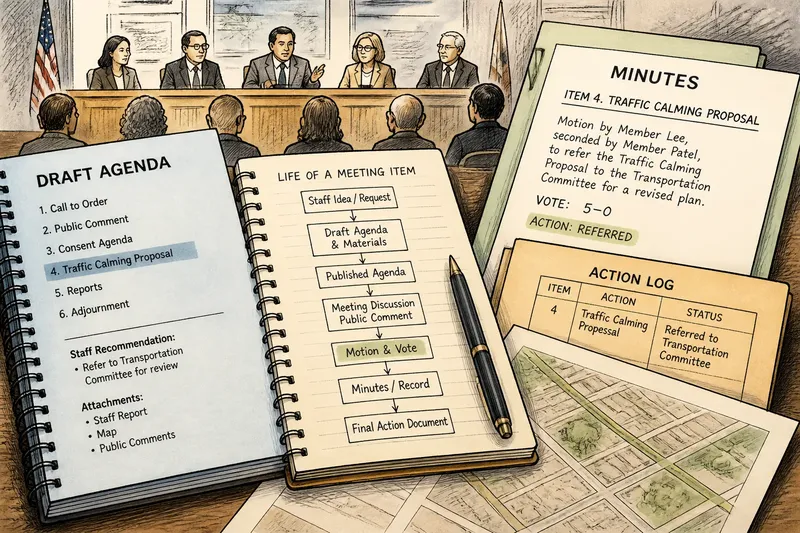
A draft agenda is a proposed route through a meeting. The final agenda shows what the body plans to take up, but neither document is, by itself, the action taken. The item’s path may involve staff preparation, public notice, discussion, a motion, a vote, and later publication of minutes or a separate resolution. The exact names and sequence differ by institution.
Choose the document that answers your question
There are several useful ways to follow an item. Each suits a different question, and none should be mistaken for the whole record.
- Agenda-first tracking suits someone who wants to know what may come before a board or council. It reveals the scheduled topic, the responsible department, and often supporting materials. It does not establish that members discussed or approved anything.
- Meeting-first tracking suits someone who needs to know what happened in the room. A livestream, recording, or attendance at the meeting can reveal the exchange and the motion as it unfolds. It may not provide the final, corrected written record, and a recording can be difficult to search.
- Record-first tracking suits someone checking the formal outcome. Approved minutes, a signed resolution, or an official action log can show what the body adopted. These records may appear after the meeting, so they are less useful for deciding whether to attend or submit a comment beforehand.
Think of the agenda as a table of contents, not the book’s final page. It points you toward the item; the minutes and action documents tell you what happened to it. For a question about what to do next, such as whether a permit request was approved, start with the final action record and work backward if details are unclear.
A draft item becomes a scheduled topic
A meeting item often begins as a staff report, a request from an elected member, a public petition, or a matter carried over from an earlier meeting. Staff may prepare a memo and attachments, such as a map, proposed policy text, or correspondence. The agenda coordinator or clerk then places the proposed item into a draft agenda for review.
At this stage, wording matters. “Discussion of park access” signals a broad topic; “consideration of a proposed park access policy” suggests that a particular action may be before the body. Even action-oriented wording does not settle the result. Read the staff recommendation and agenda notes to see whether members are being asked to receive information, give direction, hold a hearing, or vote on a specific proposal.
Once published, the agenda may include a staff contact, attachments, a meeting location, and instructions for public comment. Check for a revised or final version as the meeting approaches. If a document is missing, the clerk’s office or the listed department can usually identify where it is posted and whether the item remains scheduled.
Discussion and public comment do not equal approval
During the meeting, the chair may introduce the item, staff may explain it, and members may ask questions. Public comment may occur before or after discussion, depending on the body’s rules. A speaker’s request enters the meeting record in some form, but speaking does not itself compel a vote or change the proposal.
Listen for the motion: the formal wording that puts a proposed action before the members. The chair may ask for a motion, another member may second it where required, and the body may debate or amend it. The wording can shift during discussion, so the draft agenda’s description is not always the wording ultimately voted on.
Possible outcomes include adoption, rejection, referral to a committee, postponement, or direction to staff to return with more information. A motion can also fail to receive enough support. If the body simply discusses an issue and takes no formal action, that distinction matters: public attention or supportive comments are not the same as an adopted measure.
Read the record that matches the outcome
After the meeting, the clerk or secretary typically prepares minutes or another official account. Minutes commonly identify the item, summarize proceedings, record motions and votes, and note whether a proposal passed. They are not always a word-for-word transcript. A separate resolution, ordinance, contract, or action log may carry the operative language, particularly when a formal document is required.
To verify an outcome, compare the final agenda entry with the minutes and any linked action document. Check whether the minutes are labeled draft or approved, since a draft may still be reviewed. For an adopted measure, look for the final text and any stated conditions or later steps. For a referral or postponement, note the receiving committee or the next scheduled review rather than treating the original item as resolved.
Imagine a neighborhood group sees “traffic calming proposal” on a draft agenda and expects a street change to be approved. At the meeting, members hear comments, then refer the proposal to a transportation committee for a revised plan. The observable result in the record should be a referral—not authorization to install measures. The group can then follow the committee’s agenda for the next stage.
Which meeting record should you check first?
Does an agenda item mean the proposal will be approved?
No. An agenda identifies planned business, not the outcome. Look for a motion and the recorded action before describing a proposal as approved.
Where can I find the motion and vote?
Start with the meeting minutes or the official action log, then open any linked resolution or ordinance for the adopted wording. If the minutes are not yet posted, the clerk can tell you when the record is expected to be available.
What if the minutes differ from the recording?
Check whether the minutes are still a draft and whether a corrected version has been published. If a consequential detail remains unclear, ask the clerk which official record controls and how corrections are handled.
How do I know whether an item will return?
Look for a referral, postponement, or direction to staff in the action record, then check the receiving body’s calendar and later agendas. A return date may not be set at the original meeting.
Choose your tracking approach by the decision you need
If you are deciding whether to attend or comment, use agenda-first tracking and read the attachments. If you want to understand the exchange, use meeting-first tracking and note the motion’s exact wording. If you need to state what the body formally did, use record-first tracking and confirm whether the linked action document exists.
For a complicated item, keep a simple note with the meeting date, agenda number, motion, vote, and next destination. This makes it easier to distinguish “heard,” “discussed,” “referred,” and “adopted” when the topic reappears under a new title. A clerk can clarify local document names or procedures when they are not obvious.
The main search phrase, “meeting item from agenda to public record,” describes a trail rather than a single document. Follow that trail until you can identify the action, the body that took it, and any next step. That is the point at which an agenda entry becomes a usable account of civic business.