A Listening Plan for Your First Community Meeting
A listening plan for your first community meeting helps you follow the discussion, take useful notes, and leave knowing what to learn or do next.
The common mistake at a first community meeting is preparing a speech before you know what people are discussing. You can miss the question at hand while waiting for your turn. A listening plan for your first community meeting helps you follow the conversation, learn how the room works, and decide whether to contribute.
Bring a notebook or a notes app, the meeting notice, and any access items you need, such as reading glasses or a water bottle. You do not need to arrive with a position on every issue. Think of your notes as a pocket map: mark the landmarks that help you understand where the discussion is going.
Choose one question to guide your attention
Before you arrive, choose a question you want answered. You might ask, “What change are residents requesting?” or “Which city office handles this concern?” A single question keeps you from trying to capture every comment.
Check the meeting notice for the location, start time, access information, and agenda. If it names an unfamiliar topic, look up only the basic terms you need to recognize. Save deeper research for after you have heard how people in the room describe the issue.
Bring simple tools that support listening
Pack materials that reduce distractions and help you follow up afterward:
- Meeting notice or agenda: Check whether it lists a topic you want to follow; if it does, mark that item, and if it does not, ask the organizer where the agenda is posted.
- Notebook and pen: Check that you can write comfortably; if you can, use them to capture short points, and if not, use a notes app with notifications silenced.
- Phone or tablet: Check that the device can stay quiet and accessible; if it can, use it for notes or the posted agenda, and if it cannot, put it away and use paper.
- Reading glasses or other personal access aid: Check whether you need one to read signs or documents; if you do, bring it, and if you do not, leave it out of your bag.
- Water bottle: Check the meeting location’s rules; if outside drinks are allowed and you want water, bring a bottle, and if they are not, plan to use the venue’s available options.
- One written question: Check what you most want clarified; if it relates to the agenda, keep it on your notes page, and if it does not, save it for a later conversation with the organizer.
Keep the setup light enough that you can watch and listen. If using a device makes you look down through the whole discussion, paper may serve you better.
Listen for who is speaking and what they are doing
At the start, notice who is facilitating, who is presenting information, and how residents can take part. A neighborhood association, city department, and advisory board may handle comments differently. Watch for a speaking queue, written comment option, or designated public-comment period.
Then listen for the issue beneath individual remarks. One person might describe a difficult crossing, while another asks about delivery access. Those concerns may connect, but do not assume they do. Write the possible connection as a question until the discussion makes it clearer.
Separate existing information from suggestions. A presenter might explain a current policy, offer a possible change, or ask the group to recommend an option. Mark your notes “current,” “proposed,” or “unclear” so you do not later mistake a suggestion for an adopted decision.
Take notes that preserve meaning
For each major point, record the concern or proposal, the reason offered, and the speaker’s role if you know it. “Bus stop access—riders described a long walk from the detour” is more useful than trying to reproduce every sentence. Use quotation marks only when exact wording matters.
Leave space for missing information. A question may depend on a map, a city department’s response, or a later agenda item. Note what is unknown and who or which office was named as responsible. That gives you a clear follow-up without turning a guess into a fact.
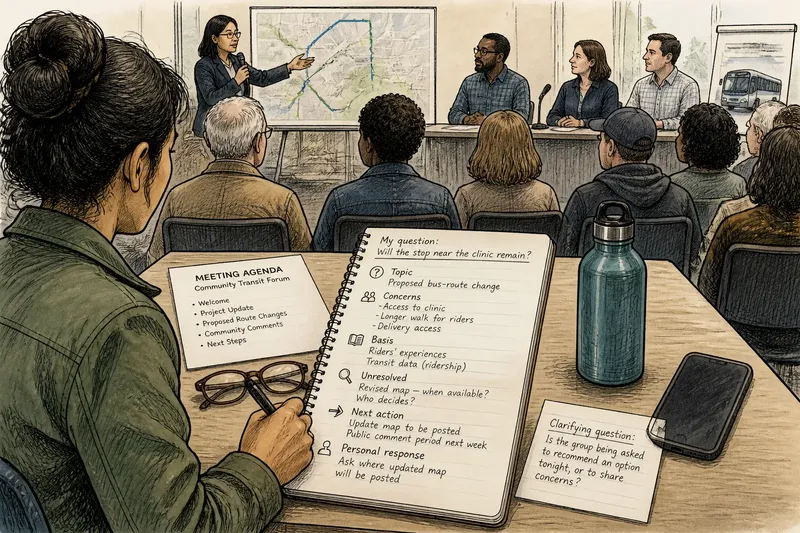
- Topic: What issue is under discussion? If you can name it, write it at the top of the page; if you cannot, note the agenda item or ask the facilitator for clarification.
- Concerns: What different experiences or options are being raised? If they differ, list them separately; if they seem connected, mark the connection as a question rather than a conclusion.
- Basis: What information or personal experience supports each point? If a source is named, record it; if none is clear, mark the claim as needing clarification.
- Unresolved issue: What information is still missing? If a person or office is named, note it for follow-up; if not, ask the organizer where to direct the question.
- Next action: What does the meeting say will happen next? If a person or office has a stated task, record it; if no task is clear, leave the item open rather than assigning one yourself.
- Personal response: What would you like to understand or contribute? If you have a focused point, keep it on your page; if not, continue listening and decide later.
Say you attend a meeting about a proposed neighborhood bus-route change. Your starting information is the posted agenda and your question: “Will the stop near the clinic remain?” You hear riders describe why they use that stop, then note that the transit presenter says the route is still under review. You write “revised map—when available?” as an open question, rather than treating the discussion as approval or rejection. Your resulting next move is to ask where the updated map will be posted.
Decide whether to speak after you understand the discussion
You can listen through a full discussion before contributing. If you want to speak, a clarifying question can help: “Is the group being asked to recommend an option tonight, or to share concerns?” It gives you a better sense of what your comment can address.
If you share an experience, connect it to the topic. Describe the place or situation, explain its effect on you, and say what you would like the group to consider. You do not need to represent everyone in the neighborhood or arrive with a complete solution.
Passing is also a valid choice. Listening, taking notes, and learning how to find the agenda are useful ways to take part, especially when the process or local terms are new to you.
What do first-time attendees often want to know?
Do you need to prepare a speech?
No. Bring one question and a way to take notes. If you decide to speak, a brief comment grounded in your own observation is enough.
What should you do with an unfamiliar local term?
Write it down with the surrounding topic instead of searching for it while the discussion continues. Ask the facilitator or a staff member during a pause or afterward.
How can you tell what the group is being asked to do?
Listen for whether the facilitator asks for discussion, recommendations, or public comments. If the request is unclear, ask what kind of response the group is seeking before deciding what to say.
Can you attend without speaking?
Yes. A first visit can help you learn the room’s routine, hear how people describe the issue, and identify what remains unclear. You can decide whether to speak at another meeting once you understand the process better.
Review your notes while the discussion is fresh
After the meeting, sort your notes into three groups: what you heard, what you still do not know, and what you may want to do next. Do not turn one person’s comment into a claim about the whole neighborhood. If you need clarification, check the posted agenda or contact the organizer or relevant city office.
A useful first meeting outcome is leaving able to describe the main question and name one point you still need to understand. Keep your listening plan for your first community meeting focused on that simple aim; it can help you decide whether to return, seek information, or speak next time.